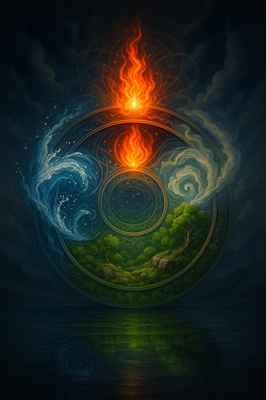
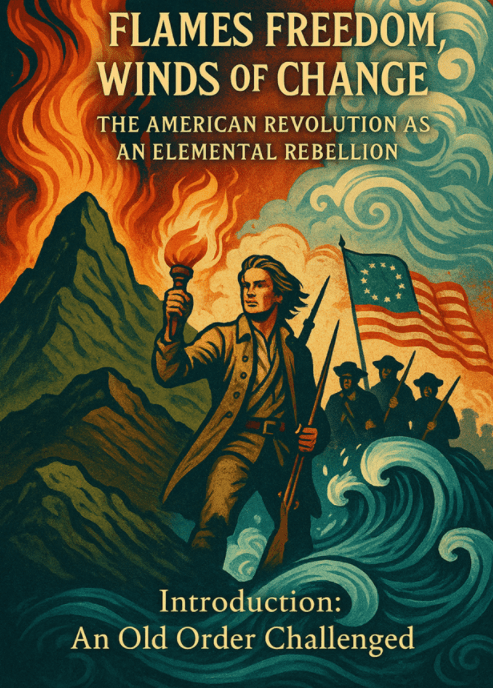
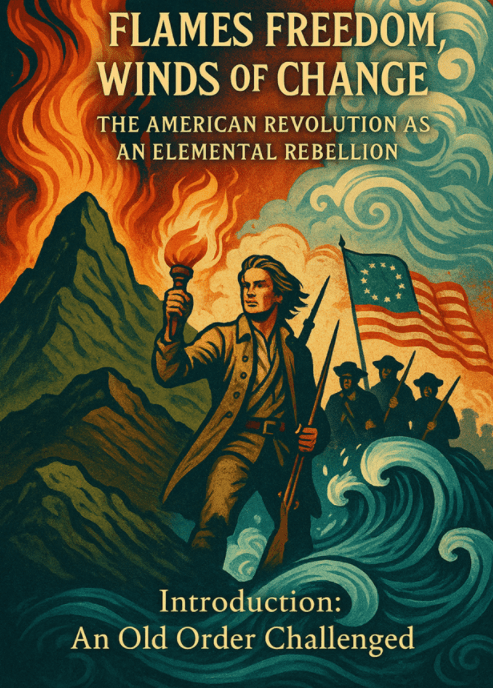
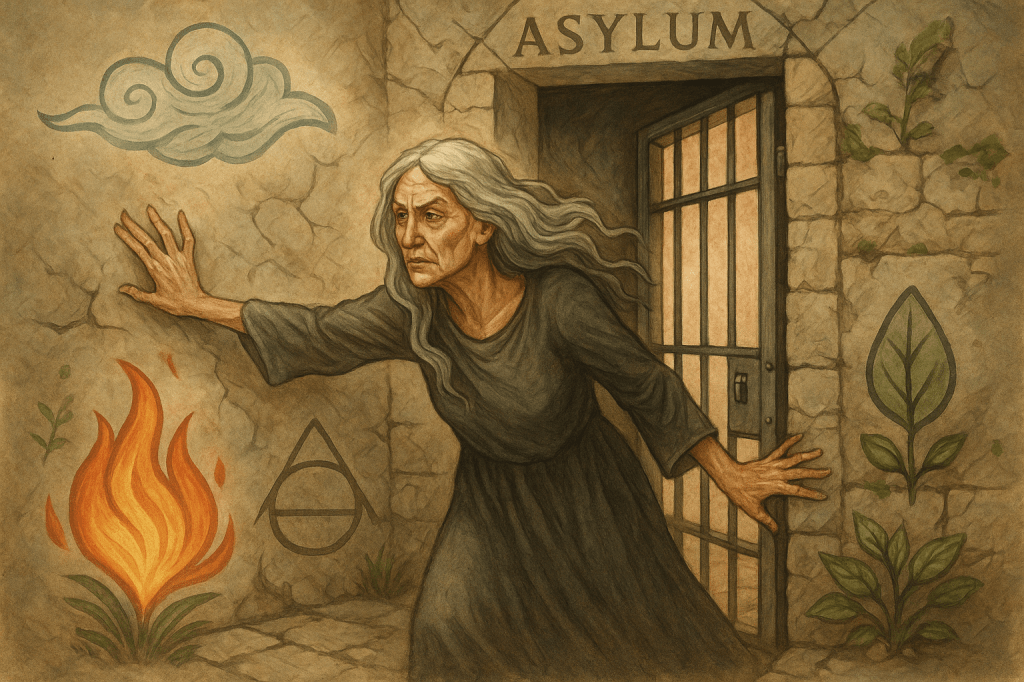
For nearly eight centuries, European civilization was bound by feudalistic collectivism under monarchial rule. Society was stratified into fixed estates and bound by mutual obligations – a rigid hierarchy anchored in land and tradition. In this medieval paradigm, governance was as heavy and immovable as Earth itself. Power flowed downward from king to lord to serf, with each person’s station fixed by birth. As one historian notes, feudal Europe “was structured in a very rigid and hierarchical way,” dominated by absolute monarchs who held all powerhistorycrunch.com. Common folk were subsumed into the collective body of the realm, owing allegiance and service with little personal agency. The Earth element in shadow loomed large: stability decayed into stagnation, hierarchy hardened into oppression. Likewise, Water in shadow permeated this old order – a dampening blanket of communal conformity that could suppress individual currents. In the name of social harmony and tradition, dissent was drowned out; the individual’s will evaporated into the collective will of crown and church.
By the 18th century, however, new elemental forces were rising to challenge this ancient order. The Enlightenment had fanned the winds of reason and struck the spark of individualism. Thinkers in Europe (including Britain) began to question whether monarchy and feudal tradition were indeed divinely ordained or merely human impositions ripe for changehistorycrunch.com. In pamphlets and parlors, the once-taboo ideas of liberty and equality spread like wildfire. The Air element – reason, ideas, communication – carried revolutionary philosophies across the Atlantic, and the Fire element – will, passion, the drive for freedom – ignited hearts in the American colonies. The stage was set for a dramatic clash of elemental energies. As one commentator describes, history often unfolds as a combat between “the stability of monarchy and the convulsions of revolution”cadmusjournal.org. Nowhere was this cosmic combat more fateful than in the American War of Independence. In essence, it became an English civil war on foreign soil – a rebellion by the colonial “children” of Britain against the long shadow of their imperial “father.” What began as a struggle over taxes and rights soon swelled into a full-blown mythic revolt, pitting New World Fire and Air against Old World Earth and Water.
Earth and Water in Shadow: The Weight of Feudal Collectivism
In the cosmology of the Revolution’s symbolism, the European feudal system embodied Earth and Water in their shadow aspects. Earth, usually the element of foundation and order, had in the Old World become order taken to an extreme. The fertile soil of tradition had turned to stone. Rigid hierarchy was the norm – kings and nobles at the summit, commoners at the base – and this hierarchy was considered as immutable as a mountain. In Britain and other monarchies, power was inherited and sanctioned by the doctrine of divine right. The social structure provided stability, yes, but it was the stability of a prison tower. The shadow of Earth cast darkness as rigidity, stagnation, and oppression. Rulers clung to power and territory, treating the land and the people upon it as possessions to be held tightly. The colonies, as extensions of Britain, were likewise expected to stay in their assigned place within this world-spanning feudal pyramid – to enrich the metropole with raw goods and obedience, never to step out of line.
If Earth’s shadow was rigidity, **Water’s shadow was conformity and suppression. Water is the element of connection, tradition, and collective life – but in the waning days of feudalism it often manifested as a flood of collectivist control that submerged individual voices. In the Old World order, one’s identity was first and foremost subject of the Crown (and often a member of a church, guild, or estate) rather than an autonomous individual. Personal hopes and rights were dissolved in the communal sea. The monarchy and its agents demanded not only taxes and labor but also fealty – an almost spiritual submission of self to the greater body of king and country. Dissenters, be they religious nonconformists or political rebels, were treated as dropouts from the great chain of being, and were often persecuted or cast out. Dissent threatened to ripple outward and disturb the still waters of society, so it was swiftly stifled. This was Water in shadow: community devolved into collective coercion. The emotional bonds that normally unite people – loyalty, patriotism, piety – were weaponized to enforce obedience. Love of country became fear of the crown’s wrath; mother Church or father King would countenance no disobedience. In such a climate, Europe for centuries remained a realm where tradition reigned supreme and change was anathema.
By the 1700s, however, cracks had appeared in this earthen fortress and leaks in the old water-tight order. The British Empire, though more enlightened than many (having a Parliament and a Bill of Rights after 1688), still treated its colonies as dependent collectives rather than equal partners. The American colonists found themselves denied the rights enjoyed by Englishmen at home – no representation in Parliament, yet bound by Parliament’s laws; restrictions on trade and westward expansion; and royal governors imposing decisions from afar. To the colonists, it felt as if the heavy Earth of British authority was smothering their growth, and the Water of imperial control was dousing their spirit. The colonies had matured – economically, culturally, and politically – but were still legally and socially treated as children bound to the royal parent. This imbalance set the stage for a dramatic elemental reaction.
Fire and Air Rising: The Spark of Rebellion
Into this fraught atmosphere, the elements of Fire and Air burst forth as the driving forces of rebellion. Air, the element of the mind and breath, had been steadily gathering in the form of new ideas. Enlightenment philosophy carried by pamphlet, press, and pulpit filled the colonial air with the language of natural rights and social contracts. Educated colonists devoured Locke, Montesquieu, and Paine; they debated liberty and tyranny in taverns and assembly halls. The Enlightenment’s raison d’être was to dispel the dark fog of superstition and unquestioned authority with the clear wind of reason. It taught that legitimate government arises from the consent of the governed and exists to secure the individual’s life and libertyhistorycrunch.com. These were revolutionary concepts: individual liberty, representative government, rule of law, and freedom of faith stood in bold contrast to the old creed of absolute monarchy and enforced orthodoxyen.wikipedia.org. In the elemental language, Air was breaking the seal of suffocating Water – encouraging colonists to see themselves not as helpless droplets in the king’s ocean, but as free citizens capable of independent thought. The winds of change carried seditious notions from Europe to America, and soon those ideas found fertile ground in the colonists’ grievances.
Where Air gave vision, Fire gave vigor. The element of Fire represents will, courage, and transformative energy – and in the colonies a righteous blaze was kindling. Years of perceived injustices struck sparks in the American soul: unjust taxes and trade restrictions lit the fire of indignation, the denial of representation fanned the flame of outrage. This flame was evident in the impassioned oratory of patriots like Patrick Henry (“Give me liberty or give me death!”) and the feverish rallying of militiamen at Lexington and Concord. Each British crackdown – from the Stamp Act to the Coercive Acts – was like fuel tossed on hot coals. Eventually the cumulative heat ignited open conflict in 1775. Fire in its noble aspect is light and warmth, symbolizing the will to freedom and the illumination of truth; here, the colonial fire was the Promethean desire to seize liberty against all odds. But fire in shadow can also be destructive rage and war’s violence. Indeed, once the war began, musket-flashes and cannon fire spread chaos. The challenge for the Americans was to harness Fire’s power for a just cause without letting it consume the very principles they fought for. Through battle and sacrifice – through blood and flame – the colonists forged a new nation. Their rebellion was passionate, often angry, yet fundamentally fueled by ideals (Air) and aspirations (Fire) rather than mere greed or anarchy.
In this sense, the American Revolution was a cosmic elemental drama. The heavy Saturnine force of the British Crown (Saturn being the planet of leaden Earth, of time and tradition) faced the swift, mercurial force of new thought (Mercury of Air) and the ardent Martian force of war (Mars of Fire). For the first few years, the conflict really was, as Britannica observes, a civil war within the British Empirebritannica.com – essentially an internal family fight, with British subjects on both sides. American colonists still saw themselves as Englishmen fighting for ancient rights rather than outright independence, at least initially. But the alchemy of war transformed their identity. The Fire of rebellion, once lit, began to transmute colonial anger into an independent American spirit. By 1776, with Thomas Paine’s Common Sense and Jefferson’s Declaration, the Air of ideas had clarified the true stakes: this was no mere protest but the birth of a new political order. Fire (will) and Air (reason) combined to illuminate a path forward, burning away old bonds and lighting the sky with the dawn of self-governance.
Father vs. Son: A Mythic Revolt on Foreign Soil
From a symbolic perspective, the American colonies can be seen as a son rising up against a father – enacting on the stage of history an archetypal drama of rebellion and self-actualization. Britain, the “mother country” (or father, in the paternalistic language of kings), had given life to the colonies through language, law, and custom. For years, colonists regarded the British monarch with genuine loyalty and filial affection. The King was often toasted as a benevolent patriarch; the colonists prided themselves on being part of the illustrious British family of nationshistory.princeton.eduhistory.princeton.edu. Yet as imperial policies grew harsher, that familial love turned to estrangement. The relationship decayed into one of abusive parent and defiant child. The Crown (especially in colonial rhetoric) began to resemble the tyrant fathers of myth – figures like King Uranus or Cronus who, fearing their children’s rise, attempt to stifle or even destroy them. Indeed, Thomas Paine seized upon exactly this imagery in Common Sense. He scorned the very idea that the colonies owed perpetual subservience to England as a “parent.” If Britain claimed to be the parent, Paine wrote, “then the more shame upon her conduct.” After all, “even brutes do not devour their young, nor savages make war upon their families”ruhr-uni-bochum.de. In other words, no true parent would treat its offspring as cruelly as Britain had treated America. Paine flipped the script, branding the supposed mother country a ravenous beast. The colonists, he argued, had fled Europe “not from the tender embraces of the mother, but from the cruelty of the monster”, and “the same tyranny which drove the first emigrants from home, pursues their descendants still”ruhr-uni-bochum.de. These fiery words invoked a powerful archetype: the Monstrous Father whom the hero-son must overcome to liberate himself and his people.
In casting Britain as an abusive patriarch, the Revolutionary narrative tapped a deep well of mythological resonance. One cannot help but recall the Greek myth of the Titan Cronus (Saturn), who devoured his offspring for fear they would usurp him. The American patriots saw in King George III a similar devourer of rights and fortunes – a Saturnine figure clutching power so tightly he would consume his own colonies’ prosperity and liberty to keep it. And like Zeus, the son who escaped Cronus’s maw and eventually overthrew him, the American colonies broke free and struck back. The Revolutionary War thus became a kind of Titanomachy on foreign soil: rebellious new gods casting down the old tyrant of the age. This father-son symbolism was not merely propaganda; it spoke to the colonists’ lived experience of simultaneously loathing and longing for the parent. Many American leaders had deep respect for British institutions – they considered themselves the true inheritors of British liberty, even as they renounced British tyranny. This is the emotional complexity of any parent-child split. The son (America) learned much from the father (Britain), even as he vowed “’Tis time to part”ruhr-uni-bochum.de.
Crucially, the Americans did not seek to annihilate all traces of their “father’s” legacy. Unlike Zeus who imprisoned the Titans, the victorious Americans chose a more nuanced path: one of rebellion with respect. They rejected the father’s cruelty but still honored the father’s wisdom where it deserved honor. The Revolution’s leaders were keenly aware that they were British in heritage – they spoke English, read Blackstone’s Commentaries, admired the Magna Carta and the Glorious Revolution of 1688. Their quarrel was with oppression, not with the entirety of British civilization. In symbolic terms, the son did not kill the father; rather, he confronted the father’s abusive aspect and then integrated the ancestral virtues into his own emerging identity. The result was a new nation that in many ways mirrored its parent culture, yet was fundamentally changed.
Transmuting Tradition: From British Legacy to American Innovation
The American Revolution was not only a war; it was an alchemical process of political and cultural transformation. The rebellious “son” nation had to forge a new identity, and in doing so it performed a delicate balancing act: retaining and transmuting the best elements of the old system while discarding the worst. This is akin to the alchemist’s work of purifying a metal – burning away dross (the toxic elements of tyranny) while preserving the gold (the noble principles and practical knowledge).
In practical terms, once independence was achieved, the United States faced a monumental question: how to govern itself? The former colonies had thrown off a king, but they could not throw off the very notion of law and order (nor did they wish to). They were determined to avoid the authoritarian control of monarchy, yet they also recognized the need for continuity and structure. In fact, the founders consciously kept many British intellectual and legal traditions, adapting them to republican use. As legal historians note, the new nation confronted a “dual challenge: to depart from the perceived oppressions of the British system while retaining the efficient and time-tested legal mechanisms that had governed their lands for centuries.”criminallawaz.com The U.S. Constitution itself was in many ways an heir to British constitutional ideas – it borrowed significantly from English legal doctrines, including the precious safeguards of individual liberty that the colonists felt had been denied to them. Concepts like habeas corpus, trial by jury, and protection against self-incrimination were not invented in Philadelphia; they were adaptations from English tradition enshrined now in a written supreme lawcriminallawaz.com. The fledgling United States adopted English common law as the bedrock of its jurisprudence, recognizing that it would be folly to abandon such a useful foundation. Judges, lawyers, and lawmakers in the early republic continued to cite English precedents and read English legal treatises – a testament to the enduring influence of the parent culture on its upstart childcriminallawaz.com.
Yet for all this continuity, there was also profound change – a transmutation of the elemental balance. The Earth element, which in the old feudal context had meant rigid hierarchy, was re-forged into a new form: the rule of law based on a written constitution. This was Earth made light – stability and structure in service of liberty, not oppression. Titles of nobility were abolished; land could be owned without feudal dues. The Water element, once collective submission, was reborn as voluntary union – the thirteen states binding themselves together by choice and shared principles, not by force. American society would still value community and tradition, but these would flow from the people upward. Meanwhile, the triumphant elements of Fire and Air were institutionalized in constructive ways. The fire of revolutionary zeal cooled into a lasting warmth: an energetic spirit of enterprise and innovation in the new republic, as well as a vigilant willingness to defend freedom. The Constitution’s checks and balances ensured that no single flame would rage out of control, preventing any new tyrant from arising. The air of Enlightenment reason was crystallized in governing charters and bills of rights. Free speech, free press, freedom of religion – all air-like liberties – were safeguarded, allowing the open exchange of ideas to continue guiding the nation. In short, the United States attempted to balance the four elements in a new harmony: Earth (law and order) anchored liberty rather than smothering it; Water (community) flowed freely rather than pooling under royal authority; Air (reason and rights) kept circulating; Fire (will and courage) burned in the hearth of national pride without setting the house aflame. The table below illustrates this elemental shift from Old World to New World governance:
| Element | Old World (Feudal Monarchy) | New World (Revolutionary Republic) |
| Earth | Rigid Hierarchy: Social order is fixed and top-down (king > nobles > commons). Stability but no mobility. | Rule of Law: Constitutional order applies equally to all; stable institutions without hereditary ranks. |
| Water | Collective Suppression: The crown and church demand communal conformity; the individual is submerged in duties to lord and faith. | Community of Choice: A union of states and citizens by consent (e.g. “We the People”), tradition respected but open to reform; individual rights upheld within the community. |
| Air | Controlled Thought: Enlightenment stifled by dogma; press and speech are censored; authority claims infallibility. | Enlightened Ideals: Free speech, press, and religion governance based on debate, reason, and written principles (e.g. Declaration of Independence, Constitution). |
| Fire | Stifled Will: Personal ambition and dissent are quelled; war is the king’s enterprise, not the people’s. Passion often turns to violence under oppressive conditions (peasant revolts, etc.). | Liberty’s Flame: Revolutionary zeal channeled into patriotism and civic action; citizens armed with the right to pursue happiness. The energy of innovation and expansion drives the young nation. |
Table: Elemental Traits of Governance Before and After the American Revolution. The Old World system (left column) shows Earth and Water elements in their shadow form (excessive structure and suppression) and limited expression of Air and Fire. The New World system (right column) transformed these elements: Earth and Water became foundations for liberty (law and voluntary unity), while Air and Fire were embraced as guiding principles of the republic.
Conclusion: A New Balance in the Cosmic Cycle
The American War of Independence was far more than a localized political quarrel – it was, in this symbolic telling, a cosmological drama in which elemental forces and archetypal narratives played out through human events. An old epoch – marked by Earth’s unwavering hierarchies and Water’s engulfing collectivism – came to an end. In its place dawned a new epoch fired by the flame of liberty and carried on the air of enlightened thought. It was as if the very soul of the world heaved a sigh of relief and said, “Enough!” – releasing pent-up energies that had been building for centuries. The rebellious American colonies, in throwing off their chains, became agents of a broader transformation: the shift from the medieval to the modern, from the rule of kings to the rule of laws, from subjecthood to citizenship. Their success sent shockwaves through the world, heralding a new balance of elements in human affairs. No longer would Earth and Water utterly dominate; Fire and Air now had their rightful place at the table.
And yet, as we have seen, the Americans did not simply burn down the house of their fathers without salvaging useful heirlooms. They carried forth into their independence the experience of ages – the laws, languages, and lessons inherited from Europe – but renewed and reconfigured them to serve a freer society. In mythic terms, the son did not become the father he rebelled against; instead, he integrated the father’s wisdom and cast aside the father’s cruelty. This is the hallmark of true maturation. The American Revolution, therefore, can be understood as a kind of alchemical wedding of old and new: the dense metal of tradition fused with the bright mercury of innovation to forge something stronger than either alone. In the grand cycle of history, the rebellion against “800 years of feudalistic collectivism” was both an ending and a beginning – the close of an era of shadow and the opening of a new chapter of light. It stands as a testament to the enduring truth that when Fire and Air unite with vision and courage, even the weight of Earth and the currents of Water cannot hold back the dawn of freedom.


 The Daily EleMental
Leave a comment