There are moments when empires astonish—not by what they conquer, but by what they reject.
Slavery, the ancient shadow, was once as natural to human life as breath. It was there in the loam of Sumer, the stones of Egypt, the scrolls of Rome. It was Earth, bound. The default. The machinery of civilization.
And yet, in the 19th century, Britain—at the very height of its global power—began to dismantle that machinery. Voluntarily. Systematically. Elementally.
It is not outrageous to suggest that this might be the greatest moral U-turn in history. For no empire had ever done such a thing before: turned against its own wealth, against its own trade, against its own advantage… for a principle.
Slavery: A Fourfold Perversion
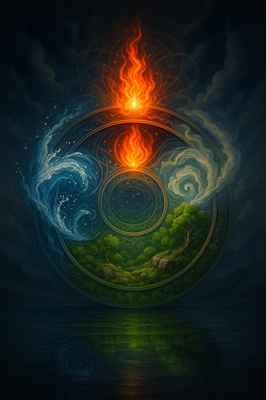
To understand what was overturned, we must see what slavery truly is—elementally:
- Earth: Enslavement is the theft of the body, the harvesting of labor, the reduction of a person to soil and muscle and coin.
- Air: It is justified through law, myth, and pseudoscience—rationalized and codified, often eloquently.
- Fire: It is driven by desire—by empire, by appetite, by conquest, by profit.
- Water: It is the rupture of soul from land, of memory from lineage, of family from self.
For millennia, all four elements were hijacked to sustain bondage.
And then, in Britain, each turned the other way.
Air Moves First
In the coffeehouses and churches of 18th-century England, something strange began to swirl through the air:
doubt.
Enlightenment thinkers and evangelical preachers alike began to ask if perhaps liberty really did apply to everyone. If perhaps man was more than a tool. Philosophers and poets gave the wind new direction. Arguments bloomed in pamphlets and parliaments. Law itself, long a servant of property, began to whisper something subversive.
Water Testifies
Then came the flood.
Olaudah Equiano’s Interesting Narrative reached thousands. Testimonies from the ships—tales of lash and rot and hunger—moved the conscience of a nation. The Atlantic, once a sea of commerce, became a sea of sorrow.
The public could no longer pretend. Water broke through.
Fire Awakens
From Water, Fire rose.
Wilberforce. Clarkson. The Quakers. Preachers aflame with gospel righteousness. Artists igniting outrage. Morality took on heat. Parliament felt the burn.
This was not politics. It was repentance. A spiritual combustion. A nation asked: What are we doing? And more importantly: What are we now called to do?
Earth Responds
At last, the ground shifted.
The slave trade was abolished in 1807. Slavery itself, in 1833. The very foundation of colonial wealth was renounced.
And then—almost unthinkably—Earth became enforcement.
The British Navy deployed squadrons to intercept slave ships across the Atlantic and Indian Oceans. This was not economic policy—it was elemental warfare. British sailors boarded vessels not for conquest, but for liberation. At great cost. For decades.
The Empire turned its ships into swords against its own former industry.
A Reversal Without Precedent
Think of it:
- An empire at its peak, voluntarily sacrificing economic power.
- A government enforcing laws that hurt its own merchants.
- A navy rerouted for no gain but the good.
What else in human history compares?
This was not perfect justice—colonialism endured, as did hypocrisy. But in this elemental reversal, the wheel itself turned.
Where once Earth had been bound, it was now unbound.
Where Air had justified oppression, it now cut the lie.
Where Fire once burned for gold, it now burned with conviction.
Where Water had carried souls into exile, it now carried the hope of return.
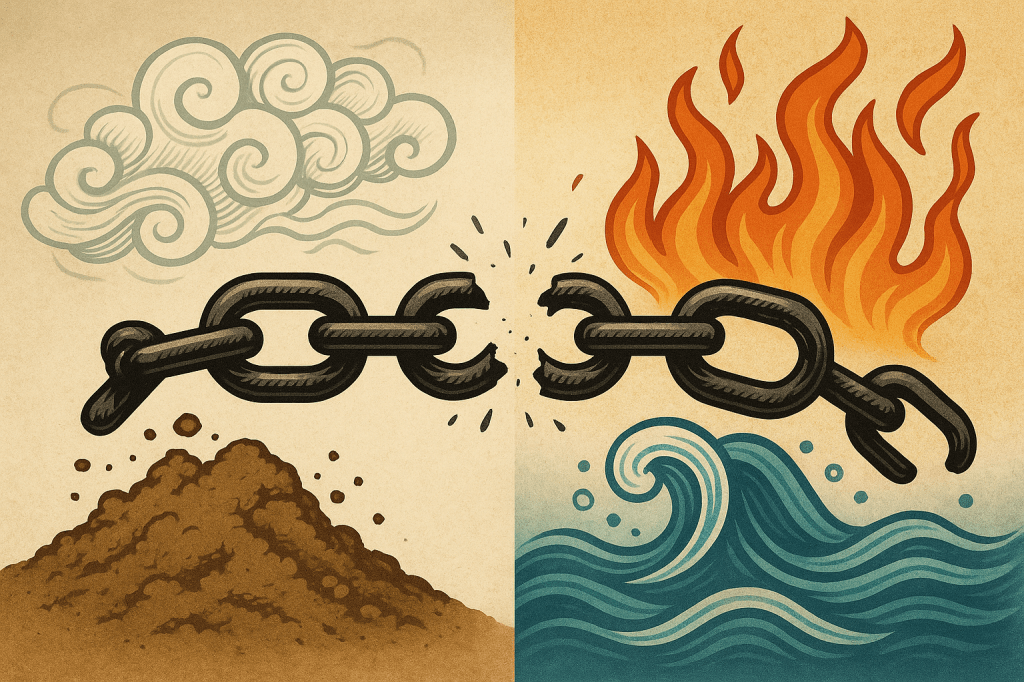
The Chain Turns Back on Itself
Slavery still exists in shadowed corners. Human trafficking, coercion, forced labor—they remind us the chain is not yet shattered.
But it has been reversed.
The idea of state-sanctioned slavery, once unchallenged, is now anathema.
And that shift—the metaphysical outlawing of bondage—is no small thing.
Perhaps it is the greatest thing an empire ever did.
Not because it was clean.
Not because it was pure.
But because it was real. A true turning. A moral combustion.
An elemental rebalancing.
 The Daily EleMental
Leave a comment