
There are rivers under Manchester.
Real ones.
Not metaphorical flows of culture or history—though he uncovers those too—but literal rivers, culverted and buried, sleeping beneath the pavements we hurry across every day. Martin Zero walks where Air was once Water, and where Water still runs—only now in the dark.
He followed the Medlock, the Irk, the Croal, and the Cornbrook like Ariadne’s thread through the labyrinth of industrial memory. The Cornbrook—a 200-year-old suburban river once open to the light—still flows, largely hidden, splitting Moss Side and Hulme as it winds past the forgotten edges of the city. It can still be walked in full, and as you follow its path, it passes directly beneath the local leisure centre, where echoes of splashing swimmers drift downward into the underground tunnel. The Water then slides silently beneath the vast, ancient Heineken brewery, before continuing on beneath the city’s direct road to its airport—a forgotten vein beneath Manchester’s daily pulse.
Eventually, Martin and his crew emerge for air, stepping into the open once more—and stumble upon something just as symbolic. On a patch of grassland, where only the lower brickwork foundations of old buildings remain, they uncover the ghost of another kind: The Reno.
This legendary Hulme nightclub, once tucked beneath the streets in a Caribbean basement bar, was a beating Fire-Water soul in Manchester’s Black cultural scene through the 1970s and 80s. Long demolished, The Reno was excavated years later by a passionate community archaeology project. Locals dug into the Earth to uncover memories: perfume bottles, coins, fragments of furniture. Martin records their reverence and awe as one of the dig’s leaders gives a spontaneous history lesson. These are not ruins—they are emotional fossils, fragments of Water and Fire once alive in this exact spot.
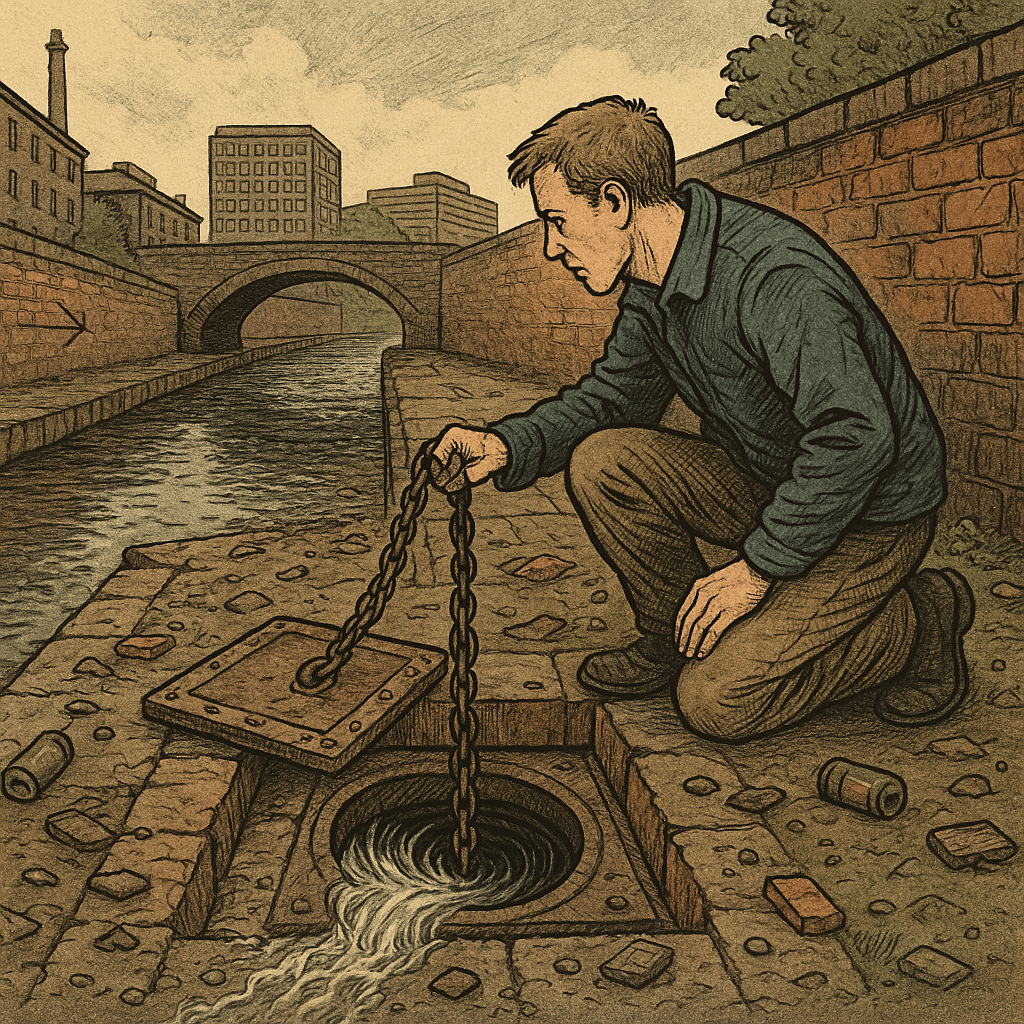
But the moment that sealed Martin Zero into legend was the day he stood behind the Ritz and the ghost of the Haçienda, and watched a 250-year-old iron plug—a hidden drain beneath the Rochdale Canal—lift from the bed of the city.
What poured out was not just dirty canal water.
It was years.
Generations.
The debris of time, and the silence of builders who thought this system would stay buried.
And there, between rust and stone, was the soul of the city remembering itself.
Martin didn’t cause it—but he was present for it.
And presence is power.
Witnessing is a sacred act in the elemental world. When Air attends Earth, when Mind sees what has been buried, something lost becomes whole again.
🎥 Watch the Moment Unfold:
“The Secret Trap Door Under The Canal” by Martin Zero
👉 https://www.youtube.com/watch?v=OZeXcH4hmtY
In this footage, Martin Zero reveals how an arrow carved into the stone quayside near lock 89 of the Rochdale Canal—close to the Haçienda apartments on Whitworth Street West—marks the location of a 215-year-old trapdoor. Set in the bottom of the canal when it was constructed at the turn of the 18th and 19th centuries, the door acts as a plughole, allowing the Water to be drained away into the culverted River Tib almost 20 feet below. (Source)
Martin Zero’s work is not just history—it’s psychogeography with soul.
He uncovers the hidden layers of the city, bringing to light the forgotten waterways and structures that have shaped Manchester’s past.
Through his explorations, he helps the city remember its soul.
 The Daily EleMental
Leave a comment