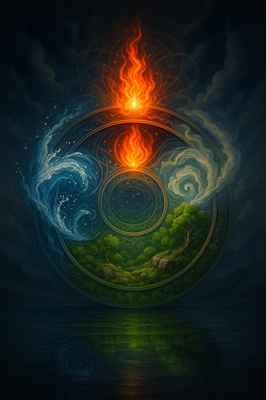
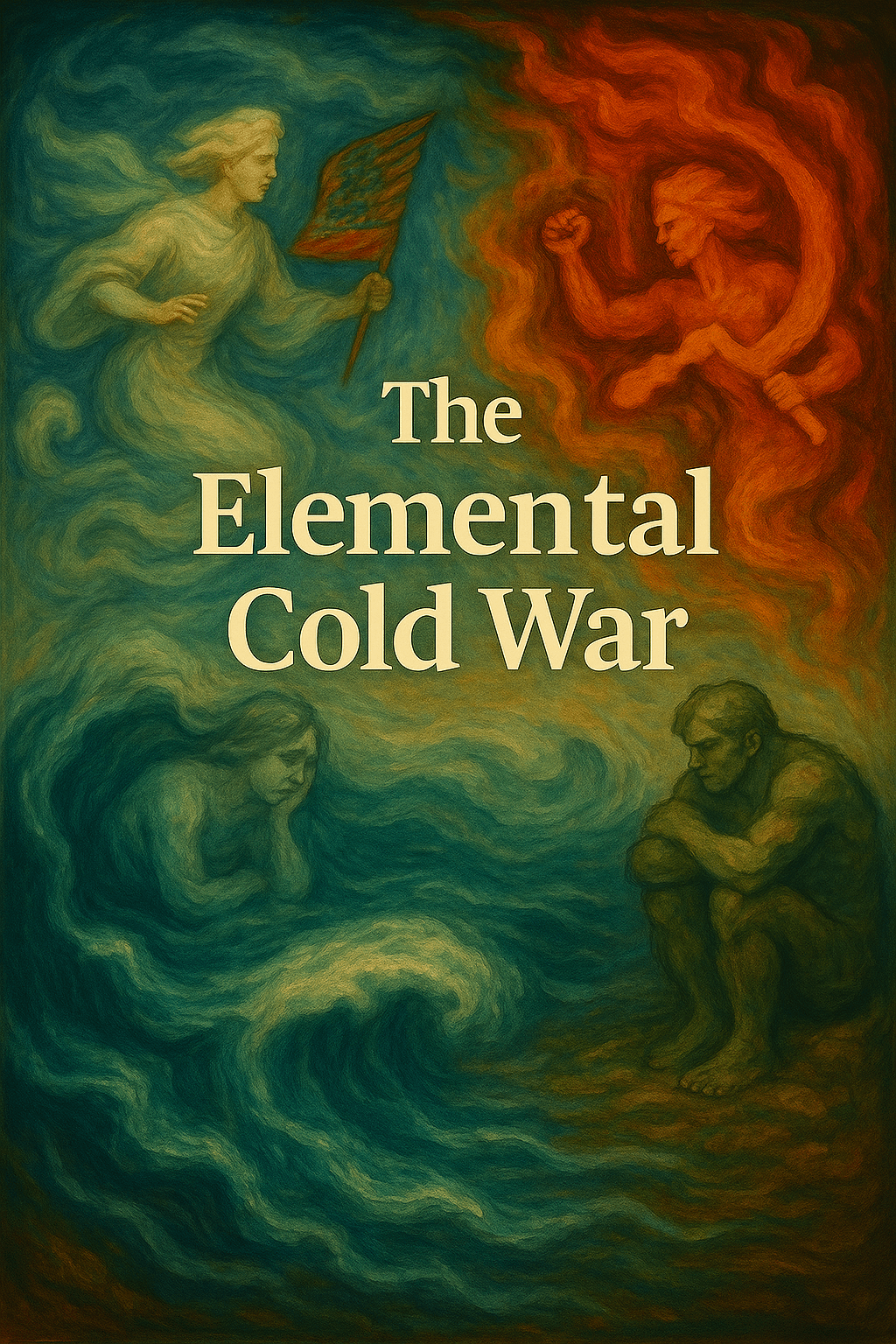
The Cold War was not merely a geopolitical standoff—it was an elemental one. A clash of mental frameworks, spiritual ambitions, emotional undercurrents, and physical boundaries. Like a cosmic standoff between gods of differing temperaments, it held the world in suspended tension for nearly half a century.
To understand its deeper significance, we must look beyond the headlines and treaties—into the hidden forces that shaped its every move: the classical elements of Air, Fire, Water, and Earth.
🜁 Air: Ideology and the War of Minds
At its core, the Cold War was a battle of ideas. Communism and capitalism were not just economic models—they were mental architectures with opposing views of human nature, liberty, and power.
- The United States framed itself as the champion of individual freedom and open markets.
- The Soviet Union declared itself the guardian of collective equality and state control.
This was Air in its purest form: abstract, intellectual, belief-driven.
Air’s influence:
- Propaganda machines acted as massive air-bellows, inflating fear and ideology on both sides.
- Think tanks, briefings, and intelligence networks replaced bullets with information.
- Mutually Assured Destruction (MAD) was born not of passion, but calculation—a cold mental construct.
But Air also casts a shadow: deception, surveillance, manipulation.
- The CIA and KGB became masters of invisible warfare—whispers, secrets, and silent coups.
- Espionage transformed Air into a chilling force of shadowed thought and strategic paranoia.
🜂 Fire: Desire, Pride, and the Need to Triumph
Beneath Air’s intellectual chess match roared a deeper force: Fire.
- The spiritual pride of both nations ignited a relentless drive for supremacy.
- The arms race was Fire made metal—willpower translated into explosive form.
- The Space Race was Fire aimed at the heavens—ambition wrapped in cosmic symbolism.
Figures like Yuri Gagarin and the Apollo astronauts became icons of aspiration, their journeys acts of symbolic transcendence.
But Fire in shadow burns too brightly:
- Proxy wars in Korea, Vietnam, and Afghanistan served as flashpoints for ideological Fire.
- Fanaticism and righteousness—on both sides—risked turning belief into absolutism.
Fire’s desire for victory often overrode compassion, threatening to consume everything in its path.
🜄 Water: Fear, Paranoia, and Collective Emotion
If Air was the mind of the Cold War and Fire its will, Water was its emotional soul—and it was troubled.
- In the West, McCarthyism unleashed a tidal wave of suspicion, dividing communities through fear.
- In the East, the Soviet surveillance state dissolved trust itself—family, friends, lovers all became potential informants.
Water’s shadow is paranoia—emotion turned stagnant and corrosive.
- School drills, fallout shelters, and “duck and cover” films became rituals of helplessness, not safety.
- Beneath both societies, a psychic ocean of dread swelled silently.
And yet, Water also offered moments of healing.
- Détente, cultural exchange, and disarmament talks brought calm.
- These fleeting moments were planetary sighs—small reminders of emotional depth beneath the fear.
🌍 Earth: Boundaries, Stasis, and Physical Manifestation
Despite all the tension, the Cold War rarely erupted into direct full-scale war. Earth was restrained—but it was still present.
- The Berlin Wall was Earth’s great symbol: a literal boundary carved from ideological difference.
- Missile silos, military bases, checkpoints—Earth manifested as containment, not conquest.
Proxy wars were Earth distorted—conflict displaced, never grounded in true resolution.
Earth also held the Cold War in place through stasis:
- The world entered a kind of frozen inertia.
- Generations lived within the Cold War’s immovable parameters, adapting to its immobile rhythm.
🔄 A Four-Element Deadlock
What made the Cold War so haunting was not that one element dominated—it was that all four were active, but none were balanced:
| Element | Expression | Imbalance |
|---|---|---|
| 🜁 Air | Ideas, propaganda, strategy | Logic without connection |
| 🜂 Fire | Pride, arms race, proxy wars | Ambition without compassion |
| 🜄 Water | Paranoia, emotional dread | Fear without healing |
| 🌍 Earth | Walls, bunkers, borders | Structure without purpose |
This was not just a standoff of nations—it was a standoff of elements.
Each force locked in place. Each afraid to move. Each threatening to collapse the balance entirely.
Only in the Cold War’s final act—when the Soviet Union dissolved and new paradigms emerged—did the elemental currents begin to shift. But even now, echoes remain.
🧭 Lessons from the Elemental Cold War
The Cold War wasn’t just history. It was a reflection of humanity’s inner architecture—our elements in opposition, rather than harmony.
To avoid repeating its mistakes:
- Let Air think—but stay connected.
- Let Fire burn—but with compassion.
- Let Water feel—but without drowning.
- Let Earth hold—but not stagnate.
Peace, in the elemental worldview, is never achieved by domination. It is achieved through balance.
Of Priests and Peers — The Tension Between Religion and Science
Long before the Cold War, another elemental shift stirred: the Renaissance and Enlightenment.
- Air awakened not as ideology, but curiosity—through literacy, rediscovered texts, and printing presses.
- Fire, once the soul of early Christianity, dimmed as the Church ossified into institutional control.
- Earth gained method in scientific rigor. Water returned through humanist philosophy.
Science rose not as an enemy of spirit, but as a tool of understanding—a union of Earth’s method and Air’s intellect, lit by Fire’s noble pursuit of truth.
Yet even this balance began to tilt.
- Science hardened into orthodoxy—peer-reviewed priesthoods replacing scriptural authority.
- Air without Fire became mind without spirit. Rationalism, when absolute, repeats the same control once exercised by religion.
Both domains, when imbalanced, betray their essence:
- Religion, meant to carry Fire (Spirit), turned to fear and rigidity.
- Science, meant to liberate Air (Mind), became a gatekeeper when it rejected Soul and Mystery.
🔁 Closing Reflection
Whether Cold War or Renaissance, politics or philosophy, the lesson is the same:
No single element can rule without distorting reality.
True understanding—of ourselves, of nature, of the divine—emerges through elemental harmony.
Let us not repeat cycles of imbalance.
Let us remember the wisdom the Cold War offers:
That peace is not passive. It is elemental alignment.


 The Daily EleMental
Leave a comment