
Introduction: A Nation Torn by Spirit
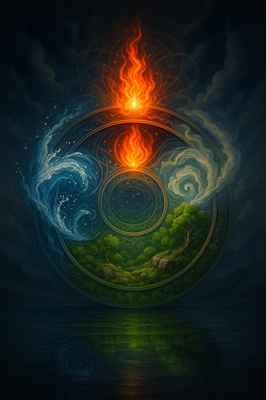
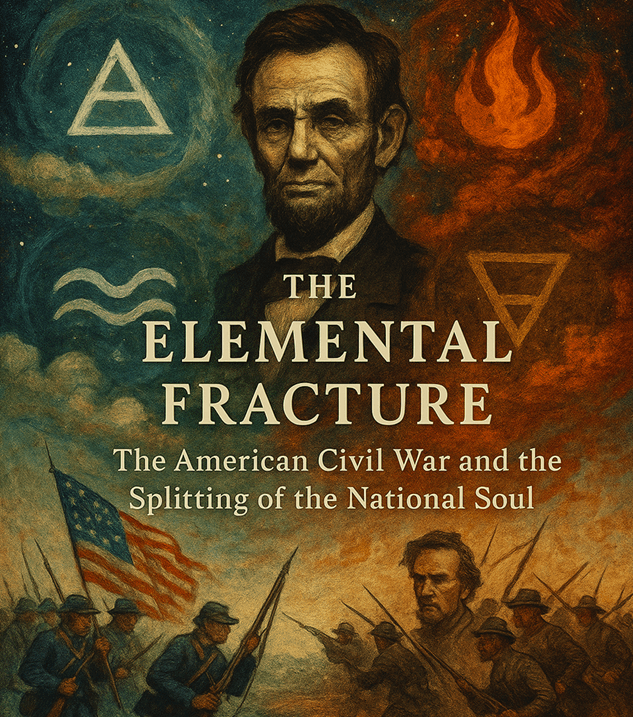
Less than a century after the American colonies declared independence from the Old World and forged a new republic from the union of four elemental forces, the young nation faced an inner reckoning. What had been united through a shared rebellion now splintered under the weight of contradictions unresolved. The American Civil War (1861–1865) was not merely a political or military struggle—it was a spiritual and elemental confrontation. A second fracture, following the original birth pangs of the Revolution, this war marked a deeper split: not of geography alone, but of ideology, soul, and elemental imbalance.
Through the lens of Air, Fire, Water, and Earth, the Civil War emerges not just as a contest between North and South, but between rival visions of human destiny—visions rooted in different elemental priorities. The Union and the Confederacy were not just political factions, but embodiments of different elemental expressions and distortions, wrestling on the same soil.
🜁 Air — The Constitution, Ideals, and the Fracture of Thought
Air, the element of principle, vision, and law, had been the scaffolding of the Republic since its founding. The Declaration of Independence and the Constitution were high-Airy acts: blueprints of a rational society built on individual liberty and mutual agreement.
But by the mid-19th century, Air had fractured. The same Constitution that espoused liberty was being interpreted to defend slavery. Thought had become split, with both sides claiming the mantle of true American ideals. The Enlightenment clarity that birthed the nation was now muddied:
- Northern Air: Progress, abolition, and universal ideals
- Southern Air: States’ rights, tradition, and selective constitutionalism
Air had become clouded—its light refracted through lenses of history, economy, and culture. The lofty ideals of the Founders were weaponized in service of incompatible visions. This split in mind and meaning set the stage for a deeper combustion.
🜂 Fire — Will, Conflict, and the Purifying Inferno
The Civil War was Fire incarnate. It was the eruption of passions long smoldering beneath the surface. Slavery, economic tension, and regional pride became the tinder; secession, the spark. From Fort Sumter to Gettysburg, fire consumed cities, fields, and families.
- Union Fire: A flame of preservation, fueled by the will to unify and eventually to emancipate.
- Confederate Fire: A flame of rebellion and self-determination, ignited in defense of a way of life rooted in ownership and honor.
In both cases, Fire burned hot. The war scorched over 600,000 lives. It razed illusions and tested the resolve of a nation. Yet fire, in its higher octave, also purifies. The Civil War, in all its horror, was a forge—burning away an untenable past to reveal a new metal of possibility.
🜄 Water — Blood, Memory, and the Emotional Undertow
Water flowed ceaselessly through the Civil War—not only in the rivers that carried supplies and bodies, but in the emotional torrent that accompanied every loss. Water is the element of collective emotion, grief, and memory.
- Songs, laments, and letters home were soaked in Water.
- Mourning mothers, weeping widows, and soldiers trembling in fear under moonlit skies—all manifestations of the war’s emotional tide.
And beyond sorrow, Water also carried the unresolved trauma of slavery:
- The tears of the enslaved,
- The yearning for freedom,
- The ancestral memory of being treated as property.
Water demands to be felt. And during the Civil War, it flowed in deluge—revealing just how much of America’s soul had been submerged beneath denial.
🌍 Earth — Territory, Institution, and the Cracking of Form
Ultimately, the Civil War was fought over the land—its use, its boundaries, and its future. Earth represents structure and possession, and here the clash was absolute:
- Southern Earth: Plantation economy, slavery-based wealth, the soil as dominion.
- Northern Earth: Industrial development, expanding infrastructure, the land as opportunity.
The war fractured the very ground of national identity. Battles were fought on family farms and ancestral lands. State lines became fault lines. Institutions cracked—churches split, parties collapsed, and the form of the Union itself was torn and remade.
But as with all elemental cycles, Earth eventually reasserted. From the rubble of war rose the 13th Amendment, Reconstruction, and a new—but still imperfect—national structure.
🔄 The Second Elemental Schism
If the American Revolution was a rebellion against external tyranny (Old World Earth and Water), the Civil War was a rebellion against internal contradiction. It was the second splitting of the elemental egg. The child born in 1776 had reached adolescence—and in that adolescence, its inner divisions could no longer be masked.
The American Civil War thus stands as a critical alchemical phase in the life of the republic:
- Air had to be clarified.
- Fire had to be faced.
- Water had to be wept.
- Earth had to be reforged.
🌀 Conclusion: The Echoes That Remain
The Civil War did not end the elemental struggle—it transmuted it. America emerged altered, but not yet whole. The shadows of slavery, division, and unhealed grief remain.
Yet this chapter reminds us: no nation evolves without elemental confrontation. No soul matures without revisiting its internal rifts.
The war between North and South was also the war within the American spirit—a necessary combustion in the great wheel of becoming.
And as the wheel turns again in our own time, we may yet feel the heat, hear the cries, and walk again the battlefields—this time not with muskets, but with memory, myth, and the possibility of balance.


 The Daily EleMental
Leave a comment