
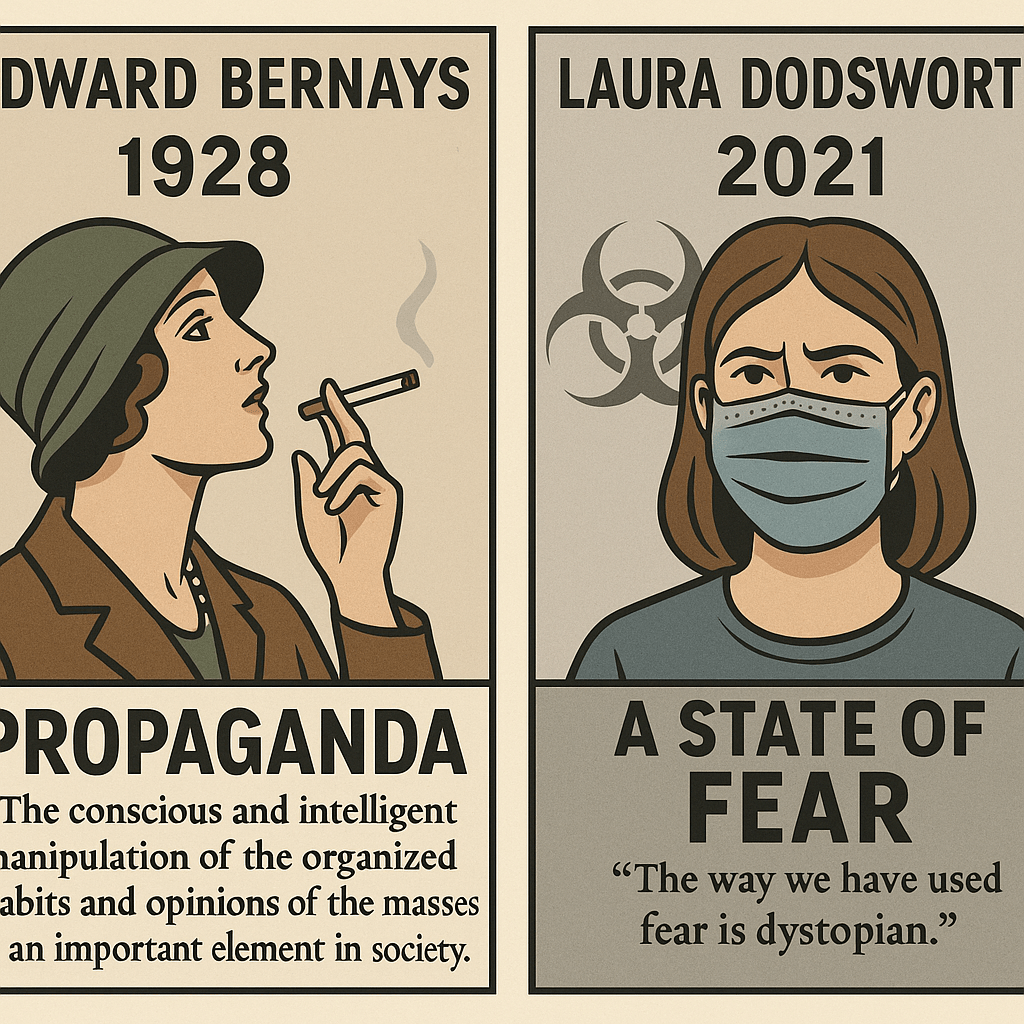
In 1928, Edward Bernays published a slim but seismic book titled Propaganda. Nearly a century later, in the wake of the COVID-19 crisis, Laura Dodsworth published A State of Fear: How the UK Government Weaponised Fear During the Covid-19 Pandemic. Though the authors are separated by ninety-three years, their works are mirror images: one a blueprint, the other a case study in its execution.
Together, they tell a chilling story of how psychological manipulation—once theorized as a tool of persuasion—became a mechanism of mass compliance and government control.
🧠 The Architect: Edward Bernays and the Engineering of Consent
Edward Bernays, the nephew of Sigmund Freud, didn’t shy away from the term “propaganda.” He simply rebranded it. To him, propaganda was not an evil—it was a necessary function of modern democracy. In his words:
“The conscious and intelligent manipulation of the organized habits and opinions of the masses is an important element in democratic society.”
Bernays believed that as societies became more complex, public opinion would need to be guided by an elite class who understood psychology, media, and group behavior. In fact, he saw manipulation as a form of social hygiene—a way to maintain order in the chaos of democratic plurality.
But even Bernays acknowledged that the techniques he promoted could be used for good or ill. His infamous 1929 campaign to normalize female smoking—casting cigarettes as “Torches of Freedom” in the name of women’s liberation—was a masterstroke of PR. It was also, ultimately, a disguised marketing operation for Big Tobacco.
He showed the world how to take a vice, wrap it in virtue, and sell it as a revolution.
📘 The Chronicler: Laura Dodsworth and the Machinery of Modern Fear
Fast forward to 2021. In A State of Fear, British journalist and author Laura Dodsworth offers a forensic look at how the UK government deployed behavioral science tactics to amplify fear during the COVID-19 pandemic.
Drawing on interviews with members of the UK’s Scientific Pandemic Insights Group on Behaviours (SPI-B), Dodsworth reveals that psychological nudges were not side effects—they were central policy.
These tactics included:
- Inflating perceived personal risk, even among low-risk groups.
- Using morally loaded slogans like “Don’t kill Granny.”
- Deploying media imagery designed to shock and disturb.
- Framing dissent as dangerous, selfish, or even treasonous.
One SPI-B insider confessed: “The way we have used fear is dystopian.”
The parallels to Bernays are striking. Just as he framed smoking as emancipation, modern governments wrapped obedience in the language of altruism and public duty. The tools were no longer experimental—they were institutionalized.
🔄 From Blueprint to Battlefield: A Century of Psychological Governance
What Bernays imagined, Dodsworth witnessed. The table below captures the continuity between theory and practice:
| Bernays (1928) | Dodsworth (2021) |
|---|---|
| Advocated the manipulation of public opinion as essential to democracy | Documented the deliberate use of fear to control pandemic behavior |
| Used emotion-laden campaigns (e.g. women’s liberation) to drive commercial agendas | Governments used moral pressure (“save lives”) to enforce lockdowns |
| Treated media as an instrument of mass persuasion | Showed how media became a megaphone for official fear narratives |
| Warned that propaganda could be abused | Warns that we have now crossed the ethical line into abuse |
In both cases, the public was not treated as a body of autonomous individuals, but as a malleable collective, responsive to stimuli and direction—if the message was potent enough.
🧭 The Moral Reckoning: Who Decides What’s “Good”?
Bernays believed that those in charge of messaging—public relations experts, scientists, governments—would steer society for the greater good. But he left a dangerous question hanging: Who defines “the good”?
Dodsworth shows what happens when that question is answered by fear, bureaucracy, and groupthink. When governments play god with psychological levers, trust dissolves, division grows, and mental health collapses. What begins as messaging becomes manipulation. What begins as protection becomes control.
The pandemic, for all its genuine risks, became a stress test not just of health systems, but of democratic principles.
🧬 Information vs. Manipulation: The Fork in the Road
At its best, communication informs. At its worst, it engineers. Bernays wrote that information was power, but when selectively curated, fear-based, and morally charged, it becomes a tool of compliance rather than consent.
Dodsworth’s A State of Fear is not merely a pandemic postmortem—it is a warning. The tools designed to keep us safe can also be used to keep us quiet. And once deployed, they are hard to put back in the box.
⚖️ Final Reflection: The Torch and the Lockdown
In 1929, Bernays lit a metaphorical torch—a cigarette brandished as a symbol of liberty. Nearly a century later, the torch has changed hands, but the symbolism persists. Only now, instead of lighting cigarettes, we are extinguishing dissent. Instead of “freedom,” the slogan is “safety.” But the tactic is the same: emotional persuasion disguised as moral necessity.
The question we face now is not whether fear works. It clearly does.
The question is: Who controls it, and to what end?
🔷 Elemental Balance of This Article
“The Torch and the Lockdown: From Bernays to Dodsworth”
Air (Ideas, Narrative Control, Language): 45%
Fire (Intent, Will, Ideological Drive): 20%
Water (Emotion, Fear, Psychological Influence): 25%
Earth (Systems, Institutions, Societal Structure): 10%
Dominant Element: Air
This article is driven overwhelmingly by Air—the manipulation of thought, language, and narrative from Bernays’ blueprint to Dodsworth’s exposé. Water plays a key supporting role, representing how emotion (especially fear) was weaponized to influence behavior. Fire represents the intent behind both propaganda and resistance to it, while Earth appears least—present as institutional background, but not the focal point.

 The Daily EleMental
Leave a comment