
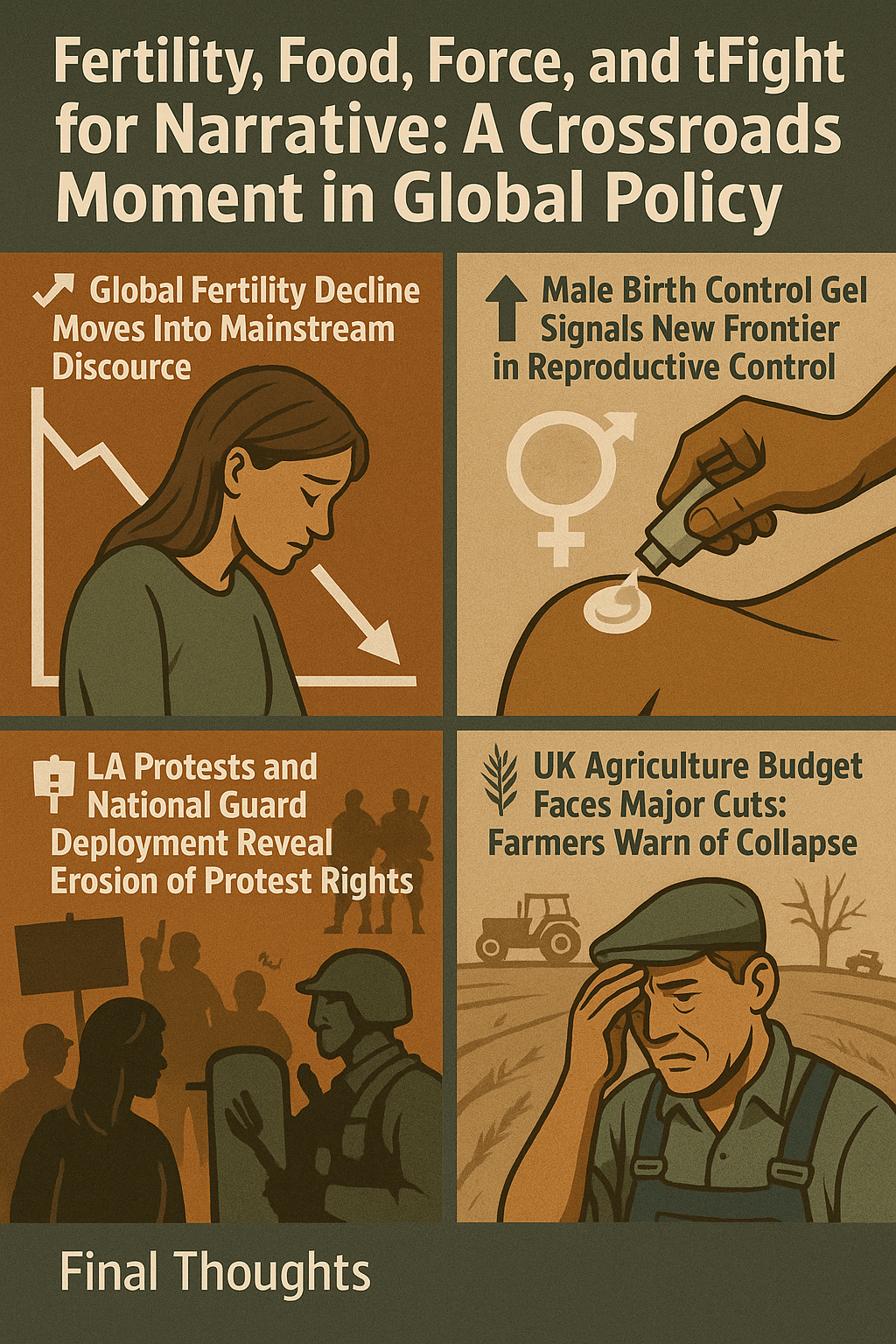

June 2025 — As the world barrels deeper into a techno-bureaucratic age, several headlines converging this week reveal a concerning synergy: declining fertility, rising state control, agricultural erosion, and escalating media manipulation. Though seemingly disparate, each thread tells a story of shrinking personal autonomy and expanding central power.
📉 Global Fertility Decline Moves Into Mainstream Discourse
For years, global fertility rates have been in steady decline, particularly in industrialized nations. But recent United Nations data now confirms a worldwide collapse in birth rates, stretching across continents—from North America and Europe to Asia and Africa. The causes are multifaceted: economic instability, lack of time, deteriorating health conditions, and changing cultural priorities. However, deeper structural causes remain largely unexamined in mainstream reporting.
Studies and documentaries have pointed toward less-visible drivers of infertility: endocrine-disrupting chemicals in household products, pesticides, pharmaceuticals, and plastic packaging. Add to this modern sedentary lifestyles, rising diabetes, and chronic stress—and the biological machinery of reproduction begins to grind down. What was once a background concern has now entered the front pages.
🧪 Male Birth Control Gel Signals New Frontier in Reproductive Control
As natural conception declines, solutions from the pharmaceutical sector continue to proliferate. One of the more striking developments this week is an experimental hormonal gel for men, designed to suppress sperm production when rubbed daily into the shoulders. Heralded as “reversible,” the gel works by disrupting testicular hormone function—raising serious questions about long-term impacts on male health.
The product is being developed in part by the Population Council, a nonprofit organization founded in 1952 by John D. Rockefeller III. Its involvement immediately raises concerns for many critics, given the Council’s historic links to population control advocacy, eugenics-adjacent policies, and centralized medical oversight. When viewed in tandem with ongoing declines in natural fertility, some worry that reproductive autonomy may soon become tethered to institutional gatekeepers.
🪧 LA Protests and National Guard Deployment Reveal Erosion of Protest Rights
Meanwhile, the streets of Los Angeles are once again a flashpoint, as thousands protest immigration policies and the deployment of ICE (Immigration and Customs Enforcement) personnel. In response, 4,000 National Guard troops and 700 Marines have been mobilized—prompting accusations of overreach, particularly from California Governor Gavin Newsom, who labeled the deployment “reckless.”
Footage circulating online shows protestors being charged by mounted LAPD officers and rubber bullets fired at journalists. Critics point out that tribal reactions now dominate public sentiment: many defend police brutality when it targets ideological enemies but condemn it when roles are reversed. This weaponized tribalism, observers warn, could normalize authoritarian tactics under the guise of partisan justice.
The danger, they note, is not who gets trampled today—but the precedent it sets for who can be trampled tomorrow.
🌾 UK Agriculture Budget Faces Major Cuts: Farmers Warn of Collapse
Back in the UK, rural communities brace for impact as rumors swirl about a significant budget cut to agricultural funding in the upcoming government spending review. According to leaked reports, Chancellor Rachel Reeves may reduce subsidies for farmers and environmental schemes—a move that has drawn strong rebukes from the National Trust, RSPB, and major farming coalitions.
The letter, addressed to the Food Security and Rural Affairs Ministry, warns of “catastrophic” outcomes for both biodiversity and rural economies. Critics argue that this policy continues a wider trend: undermining local, organic farming in favor of centralized, industrial models and reducing the nation’s food sovereignty.
The strategic weakening of agriculture mirrors similar developments in the Netherlands, Poland, and the United States—where regulatory pressures and climate policy are driving farmers off their land. Many see this not as random mismanagement, but as part of a deliberate push to depopulate rural areas, consolidate land, and transition populations into controlled urban zones—often rebranded as “15-minute cities.”
📺 BBC Considers Tying License Fee to Property Value
As trust in legacy media wanes, the BBC is facing a funding crisis. Its latest proposal: linking the annual TV license fee to property value, to be collected automatically through council tax. This shift would effectively eliminate the ability to opt out, even for households who never watch BBC content.
The rationale is that wealthier households can afford to pay more. But for many, the deeper concern lies in being compelled to pay for a service they neither use nor trust. Calls for the BBC to adopt a subscription model—like Netflix or Amazon Prime—have been rebuffed. Observers note the likely reason: such a model would expose the true size of the BBC’s current audience and potentially collapse its funding.
Public confidence in the BBC has eroded rapidly in recent years, particularly among under-40s, many of whom associate the broadcaster with bias, gatekeeping, and institutional failure. The organization’s defense—that it is a “British institution”—rings increasingly hollow to a generation skeptical of forced contributions to narratives they perceive as skewed or censored.
🧠 Controlled Opposition and Manufactured Consent
One final thread woven through all these events is the concept of manufactured opposition. As public frustration grows, charismatic figures are often elevated—figures who speak to real concerns but may ultimately channel dissent into safe, managed lanes. The recent media rehabilitation of Nigel Farage, for example, raises questions: why now? Why the sudden shift in tone from outlets that previously vilified him?
In the United States, Donald Trump fulfilled a similar role for many—rallying the disillusioned, yet ultimately failing to dismantle the very systems they opposed. As economic hardship deepens, and citizen outrage swells across the Western world, more such figures may emerge—echoing the public’s anger while unknowingly guiding it into controlled defeat.
🧩 Final Thoughts
These developments—declining fertility, reproductive gatekeeping, state-sanctioned force, farmer suppression, and narrative enforcement—are not isolated. They form a tapestry of centralization. As citizens become dependent on institutions for food, reproduction, safety, and information, the potential for genuine autonomy shrinks.
Understanding this convergence is the first step toward resisting it.
🔷 Elemental Balance of This Article
“Fertility, Food, Force, and the Fight for Narrative – June 2025 Current Events Digest”
- Air (Clarity, Critical Thinking, Media Control, Propaganda Awareness): 30%
- Earth (Farming, Food Sovereignty, Physical Autonomy): 30%
- Fire (Force, State Power, Controlled Opposition, Protest Energy): 25%
- Water (Vulnerability, Dependency, Fertility Crisis, Reproductive Health): 15%
Dominant Elements:
Air and Earth in strong interplay—truth-seeking versus control of the tangible world—with Fire as the mechanism of enforcement and Water as the suppressed human condition beneath it all.
Summary:
This article maps a convergence of control vectors—fertility, food, force, and narrative—into a unified crisis of autonomy. Air exposes the manipulation: sterilization masked as liberation, digital surveillance cloaked in safety, and media coercion spun as impartiality. Earth reveals the stakes: the land itself is being stripped from those who feed us. Fire rumbles at the edges, in protests and force deployments, as the state’s glove tightens under tribal applause. And Water, the forgotten depth—fertility, birth, care—becomes a system-managed function. Beneath it all, a question forms: Can a people be free when the most natural acts—eating, birthing, speaking—are governed by those who do not love them?




 The Daily EleMental
Leave a comment