
In ancient philosophy, Stoicism was not a denial of emotion, but a discipline of dignity — a way of aligning the soul with the order of nature and the unpredictability of fate. It was Earth in the psyche: unmoved by storms, unshaken by praise or blame, rooted in principle rather than passion.
But somewhere along the arc of modernity, the figure of the Stoic was misunderstood and misrepresented. He became cold. Repressed. A caricature. And with the rise of popular emotional culture — animated by Disney ideals, social media oversharing, and therapeutic excess — Stoicism was buried beneath slogans like “Follow your heart” and “Let it all out.”
🌬️ The Air of the Age: Thought Without Ground
Today, we live in a time dominated by the element of Air — thought, speech, media, and mental abstraction. Words fly fast and loose. Every opinion must be voiced. Every grief tweeted. Every inner tremor narrated in real time.
We are encouraged to feel everything, say everything, process everything, until the soul is frayed and the world becomes a hall of mirrors. But with no Earth to ground the Air, we drift — or worse, we spiral.
Without stoicism, there is no floor beneath our feelings.
🔥🌊 The Fire-Water Feedback Loop
At the same time, emotional culture has elevated Water and Fire to mythic extremes:
- Fire as impulse, outrage, and unchecked desire.
- Water as boundless vulnerability, catharsis, and raw exposure.
But without Earth to contain them, these elements consume themselves and others:
- Rage without resolution.
- Grief without growth.
- Passion without prudence.
We have forgotten that the strongest emotions are often held, not shown. That containment is not the same as suppression. That stillness is not apathy — it is power under control.
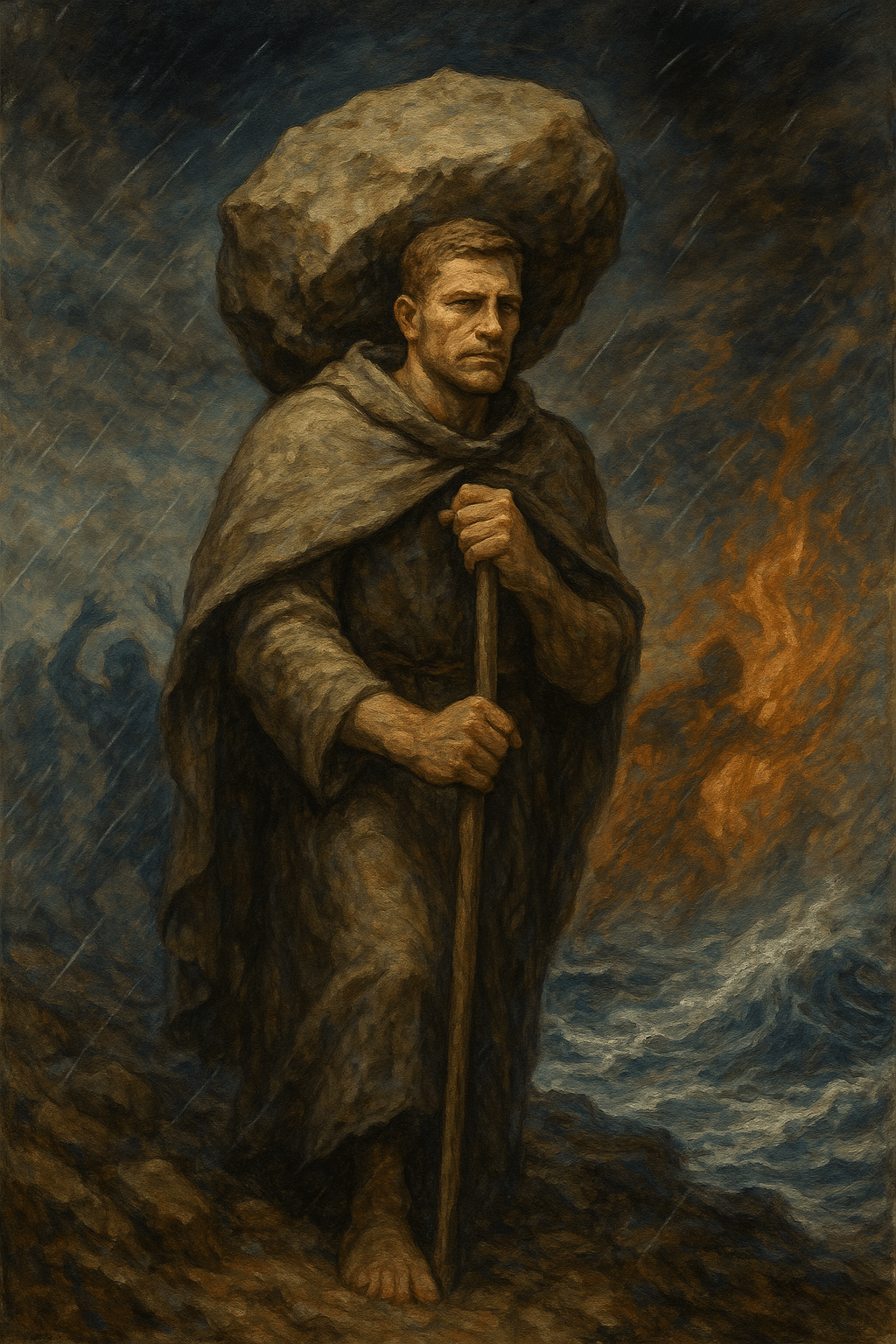
🪨 The Return of the Stonebearer
And so we return to a forgotten archetype:
The Stonebearer.
A figure both mythic and real. A symbol of the Earth element restored to dignity.
He (or she) does not share every wound.
Does not chase every whim.
Does not demand to be seen in their suffering.
But feels deeply, acts precisely, and endures silently.
The Stonebearer is not emotionally dead — but emotionally tempered.
They have carried grief so long it became granite, not to be discarded, but shaped into wisdom.
In times of crisis, others turn to the Stonebearer — not for fireworks, but for solidity.
Not to be entertained, but anchored.
🧱 Stoicism and the Moral Spine of Civilization
This trait — often confused with coldness — is what builds civilizations.
Stoicism raises children, leads families, endures injustice without vengeance, buries loved ones with reverence, and returns to work the next morning to till the soil.
It is Earth in its noblest form:
- The builder.
- The bearer.
- The silent vow-keeper.
A society without stoicism may sparkle with emotional openness — but it cannot survive hardship, sustain order, or distinguish between principle and impulse.
Without the Stonebearers, everything collapses when the flood comes.
🌱 Conclusion: A Gentle Resurrecting
The Stoic need not be our only ideal — but it must return as a counterbalance.
Let us teach our children not just to cry freely, but to stand quietly.
Not just to speak their truth, but to withhold wisely.
Not just to feel, but to carry feeling with grace.
Let us make Stoicism noble again.
Let Earth rise.
⚖️ Elemental Balance Summary:
“The Stonebearer: On the Element of Stoicism in an Age of Emotional Excess”
- Earth (Stoicism, Endurance, Inner Containment, Responsibility): 55%
- Water (Emotional Depth, Mourning, Feeling-without-display): 20%
- Air (Philosophical Framing, Thoughtful Contrast, Cultural Critique): 15%
- Fire (Subdued Passion, Quiet Strength, Controlled Outrage): 10%
Dominant Element: Earth
Water held in reverence, Air used for structure, Fire disciplined. A restoration of balance through grounded presence.
This essay stands as a tribute to the Earth element in its purest form — not as landscape, but as moral bedrock. It reclaims Stoicism from the dustbin of modern caricature and places it where it belongs: at the foundation of a sane and enduring society.
The piece contrasts the cultural dominance of Fire and Water in their undisciplined forms — impulse and overexposure — with the silence, strength, and sacred weight of Earth. It acknowledges the loss of stoic discipline in generations raised on unfiltered catharsis and elevates the image of the Stonebearer as a mythic archetype of quiet fortitude.
Water plays a supporting role, expressing the unspoken depth of emotion behind the stoic mask. Air acts as the philosophical lens — observing, comparing, warning — but never untethered from ground. Fire is present, but controlled, refined into action rather than reaction.
This was not just an argument. It was a grounding rite.
A return to principle.
A remembrance of strength.
A stillness that does not shrink, but stands.


 The Daily EleMental
Leave a comment