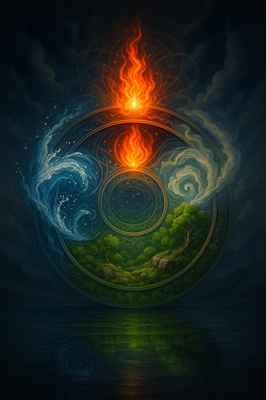
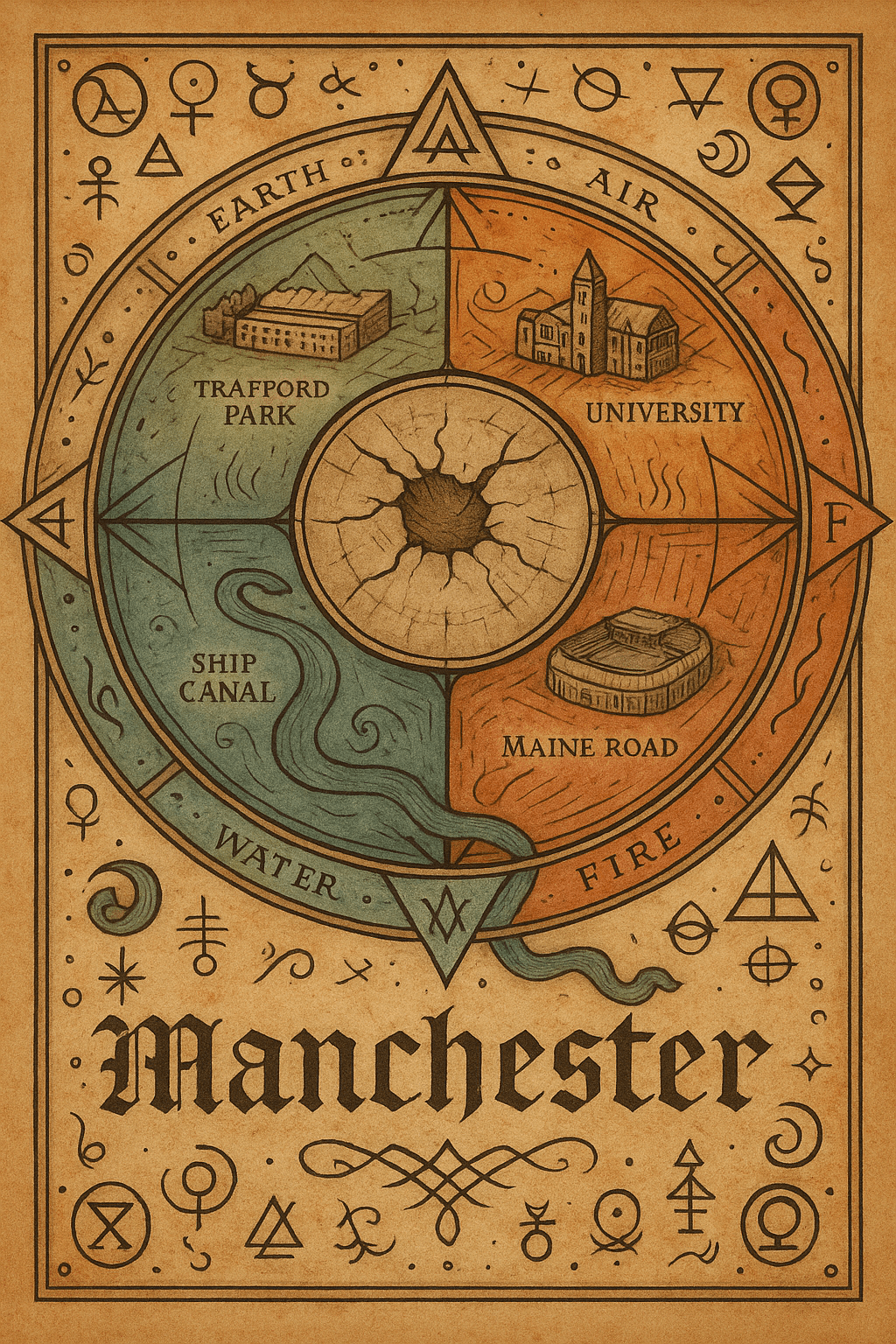
There are cities. There are engines. There are altars. And then there is Manchester—a place where the four classical elements have never merely existed but collided, combusted, and created.
If you want to understand the modern world, look no further than the first inland city to become an international port. Thirty miles from the sea but somehow reaching the globe. Manchester wasn’t built on convenience—it was built on will. On Fire. On Earth torn open and remade. But beneath that, there’s Water: memory, migration, soul. And above it all? Air—ideas, invention, electricity in the mind.
Let’s begin, briefly, with the ancients…
Foundations – From Rome to Revolution
Roman Mamucium was Earth claiming territory. Roads and fortifications sliced through Celtic Water, organizing chaos with Air and military logic. But these were only flickers. For over a thousand years, Manchester remained a murmur.
That changed in the late 1700s when Fire was crowned.
Earth and Fire Unleashed – The Industrial Alchemy
Imagine a cauldron of mills, soot, canals, sparks, and steam. This was no city—it was an alchemical furnace. The Bridgewater Canal (1761), the first artificial waterway, bent Water to Earth’s will. Then Arkwright’s steam-powered mill (1783) lit the Fire that transformed labor into lightning.
Manchester became the world’s first modern city. Not because of wealth alone, but because it revealed what happens when Fire (desire, drive) fuses with Earth (infrastructure, form). The very geography was altered: the first railways, the first commuter towns, the first reservoirs, all built to feed a city ablaze with purpose.
And yet beneath the machinery, the Water still pulsed—immigrants, workers, children, songs.
The Inland Port and the Irish Road
Only in Manchester could they build a port 30 miles inland. The Ship Canal was more than a feat of engineering—it was a message: Earth will move if the Fire demands it.
And it was the Irish, in many ways, who moved it.
Here’s something I say often:
“Scousers are Irishmen who got off the boat and settled. Mancs are Irishmen who got off the boat, laid a railway, dug a canal, got to the other end and thought, ‘We’ll settle here.’”
Beneath all the banter, the football jibes, the bitter chants, is blood. Shared ancestry, mirrored struggles. Two cities born of Water, fueled by Fire, divided by Air (the tribal storylines we tell ourselves).
Air Sparks, Water Rises – Music as Elemental Memory
If Manchester is an engine, music is its echo—each note a tremor of Fire or sigh of Water.
- The Hollies and Herman’s Hermits brought harmony—early Air, pop optimism.
- Buzzcocks tore that up—punk Fire, urgent, sweaty, alive.
- Joy Division came like a storm—haunting Water, cavernous echoes of despair.
- Then The Smiths: ironic Air and aching Water braided with gladioli and grit.
- New Order: Fire meets machine. Synths become sacraments.
- The Stone Roses and Happy Mondays: rave-Water, dripping with ecstasy and swagger.
- Oasis: pure Fire. Cigarettes, anthems, eyebrows. No apology, just desire.
- Elbow: tender Water and refined Air.
- The 1975: postmodern gloss, self-aware Fire in eyeliner and neon haze.
Every band, a weather system. Every club, a ritual site. And it all flowed through Factory Records, The Haçienda, and the mythos they created.
Football – Tribal Fire and Civic Water
Two great flames burn across this city—City and United. They are modern expressions of ancient Fire—ritualized warfare, identity through color and chant.
Yet football here is more than sport. It’s Water too—tribal memory, inherited loyalty. People die with club scarves in their coffin. Generations live through matchday ecstasy and existential crisis.
Oh, and the Football League? Yeah. Invented here. 1888.
The Day the Sky Shook – 1996
June 15th, 1996. A summer day. You’re sixteen. You’ve just finished your GCSEs. You’re at your aunt’s on Thornton Road, soaking up the sun, waiting for England vs Scotland in Euro 96. The back garden opens up to Maine Road, and the air’s thick with football and possibility.
Then—BOOM.
A sound not of goal celebrations but of rupture. The IRA bomb detonates just two miles away. Helicopters circle. Smoke rises. For a moment, you think Maine Road’s collapsed. But it’s bigger than that. Manchester has cracked.
And yet—not a headline. Overseas, British papers splash Gazza’s goal. Not the crater in the heart of a city.
That day stuck with you. Not just the explosion—but the realisation: media can lie by omission. Truth has to be lived, not read.
Air and Earth Rebuild – From Rubble to Reinvention
That bomb, strangely, became a kind of reset button. Manchester rebuilt not just its buildings but its identity.
- MediaCity rose.
- The Metrolink expanded.
- University science bloomed—graphene, AI, creativity indexes.
- The city became Britain’s first nuclear-free zone, the first urban heritage park, and home to the best UK airport.
- All while holding onto its defiant spirit, its I know what I am attitude.
Martin Zero calls it “the most important city in the world”—and he’s not wrong.
An Elemental CV – The Firsts that Changed the World
Let’s just roll a few off:
- First public library (1653)
- First industrial estate
- First stored-program computer
- First commuter towns
- Birthplace of modern vegetarianism
- First atom split (Rutherford, 1917)
- Birthplace of the co-op movement
- First mechanically powered submarine
- First professional football league
- Emmeline Pankhurst: here.
- Rolls met Royce: here.
- Top of the Pops: filmed here.
- And yes—Coronation Street, the world’s longest-running soap.
Manchester didn’t just keep up—it made the path.
The City of Now – All Four Elements, Crowned and Clashing
Today, Manchester is a paradox of all four elements:
- Air: digital innovation, universities, thinkers, artists.
- Fire: football, passion, rebellion, protest, pride.
- Water: community, diaspora, song, memory.
- Earth: regeneration, construction, structure.
But imbalance always looms: too much Fire can burn, too much Earth can suffocate, too much Air can disconnect, too much Water can drown.
Manchester’s story is not done. It is a crucible. Still shaping itself. Still elemental.
Closing Notes – Memory, Myth, and Mancunia
The world might think in terms of London or New York. But civilisation turned a corner here—in soot and soul, in steam and song.
And maybe that’s why, even now, as planes pass over, or trams click down old steel lines, or as Martin Zero walks the forgotten footpaths with his camera and his care, this city feels alive.
Not just alive—eternal.
This is Mancunia. An elemental city. A holy contradiction.
And if you understand Manchester, you might just understand the world.
 The Daily EleMental
Leave a comment